

Dwarka Property Rates 2026: What Is the Right Price to Pay?
By Dwarka Homes | Sector-wise guide for buyers and investors
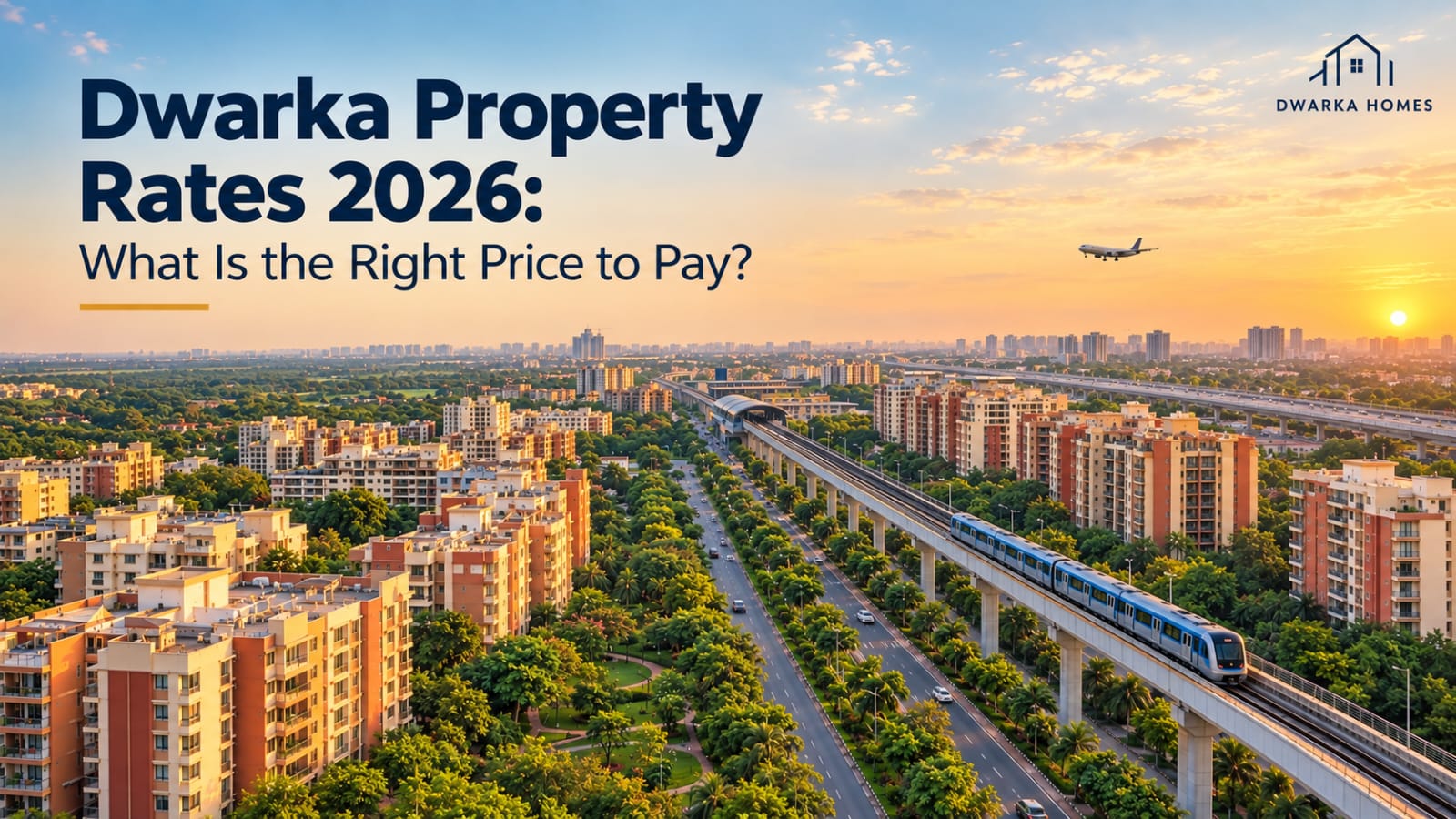
Block 1: Why Dwarka Is Still on Every Buyer's List
Dwarka is one of Asia's largest planned residential sub-cities, and in 2026 it remains one of the few parts of Delhi where you can still find a well-planned, metro-connected flat at a price that does not cross the ₹3 crore mark for most buyers.
What keeps demand strong:
• Metro connectivity: The Blue Line runs through the heart of Dwarka, and the Airport Express Line connects Dwarka Sector 21 to New Delhi and IGI Airport.
• Airport proximity: IGI Airport is a short drive away, which matters for frequent flyers and aviation professionals.
• Dwarka Expressway: The Delhi-Gurugram corridor has improved access to Gurugram and NH-48 for office-goers.
• Yashobhoomi (IICC), Sector 25: One of India's largest convention centres has added to the long-term story of the southern sectors.
• Planned layout: Wide roads, parks, markets in every sector and a good mix of CGHS societies, DDA flats and builder floors.
Block 2: How Dwarka Prices Work (Read This Before the Sector Numbers)
In Dwarka, the same sector can have a 20 to 30 percent spread between the cheapest and the costliest flat. That is because price depends on more than location.
The six factors that move the price:
1. Distance to the nearest metro station. Within 500 metres to 1 km commands a clear premium.
2. Society quality. Age of the building, maintenance, lifts, parking, security, and a clean society record.
3. Floor and facing. Park-facing and higher floors with a lift cost more. Ground floors with a garden or stilt-side are priced differently.
4. Type of ownership. CGHS (cooperative society) flats, DDA flats, and builder floors have different paperwork and transfer costs.
5. Size and configuration. A well-laid-out 3 BHK is the most liquid product in Dwarka.
6. Condition. A renovated flat can sell at a visible premium to a tired one in the same society.
Block 3: Sector Groups at a Glance
To keep things simple, we have grouped Dwarka into five zones. Use the table as a starting point, then read the block for the group you care about.
|
Sector Group |
Character (revised) |
Price range (₹/sq ft) |
Typical 3 BHK (~1,500 sq ft) |
|
Group 1: Sectors 1–5 |
Quieter and older, but now priced at core-belt levels |
₹14,000–17,500 |
₹2.1–2.6 Cr |
|
Group 2: Sectors 6–13 |
Core metro belt, still the most sought-after |
₹14,800–17,750 |
₹2.2–2.7 Cr |
|
Group 3: Sectors 14–17 |
Split market: Sector 14 (DDA-heavy) is far lower; Sector 17 is at the top |
₹11,000–17,750 |
₹1.65–2.65 Cr |
|
Group 4: Sectors 18–23 |
Highest rates in Dwarka (18, 18A, 19B); Sector 22 slightly lower; 21 and 23 not verified |
₹15,500–17,250 |
₹2.3–2.6 Cr |
|
Group 5: Sectors 24–29 |
Not a resale market; no reliable rate |
Unverified |
n/a |
Ranges are indicative for resale flats in societies and builder floors. The Dwarka-wide average is about ₹15,300–15,600 per sq ft. Premium CGHS societies near metro stations can sit above the top of each band. Sectors 24–29 have no reliable resale rate.
Current Rental Values (October 2026)
Rents in Dwarka are low compared with prices, so yields are thin. The figures below are monthly rents in decent societies, based on current listings.
• 2 BHK: about ₹22,000–35,000, with a Dwarka-wide average near ₹27,600 (about ₹29,350 in Sector 13).
• 3 BHK: about ₹30,000–50,000, with a Dwarka-wide average near ₹42,500 (about ₹43,850 in Sector 13). Core-belt asks in Sectors 6, 10, 11 and 12 run roughly ₹35,000–55,000.
• 1 BHK: average of about ₹15,850.
• Cheaper pockets: Dwarka Mor and the fringe areas see 2 BHK at about ₹11,000–22,000 and 3 BHK at about ₹14,000–22,000. A few Sector 21, 23, and 28 3 BHK listings ask ₹26,000–35,000.
• Yield: Gross yield is about 2 percent (Square Yards shows 2.12 percent for Dwarka and 1.97 percent for Sector 13). For example, a 1,500 sq ft 3 BHK bought at ₹15,500 per sq ft costs about ₹2.33 crore. At ₹42,000 a month,h it earns about 2.2 percent a year.
Rents are asking figures from a small sample of listings and vary by sector, so treat them as a guide and check live listings in your society.
Block 4: Group 1 | Sectors 1 to 5
Best for: First-time buyers and budget-conscious families.
These are among the older sectors of Dwarka. Flats are generally larger for the money, but buildings are older, so you will want to check structural condition, lift availability,ty and pending repairs.
• What you get: Generally larger flats, though per-sq-ft rates are now close to the core sectors.
• Watch out for: older construction, limited parking and a longer walk to metro in some pockets.
• Right price signal: Sectors 3 to 5 now average about ₹15,300–15,900 per sq ft, almost the same as the core belt, so the old discount has largely gone. Anchor your negotiation to the lower half of the band unless the flat is renovated and metro-adjacent, and question any quote above about ₹17,000.
Block 5: Group 2 | Sectors 6 to 13
Best for: Buyers who want convenience first and are willing to pay for it. Also, the strongest rental demand.
This is the heart of Dwarka. Many of the best-known CGHS societies are here, with metro stations, markets, hospitals, and schools close by. Sector 6, 7, 9, 10, 12 and 13 in particular tend to see the most buyer interest.
• What you get: Walkable metro access, mature societies, easy resale.
• Watch out for: Prices are firm. Sellers know what they have, and the best societies rarely stay on the market long.
• Right price signal: Sector averages sit around ₹15,100–16,050 per sq ft. Compare at least three recent deals within the same society. A 5 to 8 percent premium for park-facing or a metro-adjacent society is reasonable. Beyond that, ask for a justification.
Block 6: Group 3 | Sectors 14 to 17
Best for: Families who want a settled neighbourhood without paying the Group 2 premium.
These sectors sit between the older belt and the airport side. They offer a balance of price, space and social infrastructure, with decent metro access in the stretches near Sector 14, Sector 16 and Sector 17.
• What you get: Good value for a mature locality.
• Watch out for: Metro distance varies a lot within a sector. Check the walking route, not just the map distance.
• Right price signal: This group is uneven. Sector 14 trades far below the core, at about ₹11,250 per sq ft. Sector 17 is quoted at or above core levels (₹16,000–17,750; sources differ). Check which sector you are looking at, and if a flat is not clearly cheaper than the core, ask why.
Block 7: Group 4 | Sectors 18 to 23
Best for: Buyers who want airport proximity, Expressway access, or a growth-oriented purchase.
Sector 21 is the Airport Express anchor and has been a favourite of frequent flyers and corporate tenants. Sectors 22 and 23 benefit from the Dwarka Expressway side and the newer infrastructure around them.
• What you get: Strong connectivity, good rental potential and appreciation momentum.
• Watch out for: Prices vary widely by society. Do not assume the sector name alone justifies a premium.
• Right price signal: Check rental yield. Gross rental yield in Dwarka is currently about 2 to 2.5 percent. If the annual rent is under about 2 percent of the flat's value, you are paying more for future growth than for present income.
Block 8: Group 5 | Sectors 24 to 29
Best for: Patient investors and buyers who want new construction at lower entry prices.
This is Dwarka's newer frontier. Yashobhoomi at Sector 25 and the Expressway have lifted the long-term outlook, but many pockets are still developing, so day-to-day convenience can lag the core sectors.
• What you get: Lower entry price and potential for catch-up appreciation.
• Watch out for: Under-construction timelines, incomplete social infrastructure,e and a thinner resale market.
• Right price signal: Do not pay core-sector prices for a developing-sector address. Build in a discount for waiting time and for any approvals still pending.
Block 9: Circle Rate vs Market Rate
Delhi's circle rates have not kept pace with market prices, so in most Dwarka societies the market price is well above the circle rate. This matters for two reasons:
• Stamp duty is calculated on the higher of the circle rate or the actual sale value. In Delhi, the commonly applicable rates are 4 percent for women, 6 percent for men, and a blended figure for joint purchases.
• Banks lend against their own valuation, so the loan you get may be lower than the price you pay, meaning your down payment needs to be higher than you expect.
Please confirm current circle rates and stamp duty rules on the Delhi government's official portals before finalising.
Block 10: A Simple Checklist to Find the Right Price
Use this before you make an offer.
1. Pull three comparable deals from the same society in the last 6 to 12 months.
2. Compare per-square-foot rates, not just total price.
3. Adjust for floor, facing, and condition in rupees, not feelings.
4. Check society charges: transfer fee, maintenance dues, and any pending special levy.
5. Verify papers: society membership, allotment, sale deed or conveyance, and loan or lien status.
6. Run the rent check: typical gross yield in Dwarka is about 2 to 2.5 percent a year. If rent is clearly below 2 percent of the price per year, the price is leaning on future appreciation.
7. Leave room to negotiate: a 3 to 6 percent discount from the asking price is common in a steady market.
Block 11: Red Flags That Mean You Should Pause
• A price far below the sector average with no clear reason.
• A seller who cannot show complete society documents.
• Pending dues or disputes in the society.
• Pressure to pay a large cash component.
• A broker who will not let you meet the society office.
Block 12: So, What Is the Right Price in 2026?
There is no single number for Dwarka. The right price is the one that matches the sector group, the society, and the flat's specific features, supported by recent comparable deals and a sensible rental check.
As a rule of thumb:
• Core metro belt (Sectors 6 to 13): Expect to pay for convenience. Be firm on comparable deals.
• Mature mid-belt (Sectors 14 to 17): Look for the value gap against the core.
• Airport and Expressway side (Sectors 18 to 23): Pay for connectivity, but check the rent.
• Newer sectors (Sectors 24 to 29): Pay a discount for waiting, and buy only with clean approvals.
• Older sectors (Sectors 1 to 5): Buy space, and budget for repairs.
Talk to Dwarka Homes
We help buyers and sellers across all Dwarka sectors with society-level price checks, document verification,n and negotiation support. Tell us your budget and preferred sectors, and we will shortlist societies where the price makes sense.
Disclaimer: This blog is for general information only and is not financial or legal advice. Prices change frequently. Please verify current rates, circle rates, stamp duty, and society charges before making a purchase decision.
 DDA Flats
 Society Flats
 Retail Shops
 Studio Apartment
 Serviced Apartments
 Office Space
 WhatsApp

 Mail us


